
OpenAI announced on Monday that its AI programming smart body, Codex, had launched a new version of the Gpt-5 model GPT-5-Codex, which was able to allocate “think” time in a more dynamic way, processing programming tasks for up to a few seconds, for up to seven hours, with a significant improvement in the intelligent programming benchmark test.
The new version of the model is now available to all ChatGPT Plus, Pro, Business, Edu and Enterprise users, with access to Codex products through terminals, IDE, GitHub or ChatGPT. OpenAI indicated that future plans were to open the model to API clients.
This update is an important initiative of OpenAI to respond to the competitions of Claude Code, Cursor in Anysphere and GitHub Copilot of Microsoft. As a result of the surge in user demand, the AI programming tool market has expanded dramatically over the past year. Cursor exceeded $500 million in annualized revenue at the beginning of 2025, and the same editor, Windsurf, triggered a Google-Cognition competition.
According to the OpenAI official network, GPT-5-Codex is a GPT-5 variant that optimizes software engineering for Codex. It has been trained in complex engineering tasks, including building complete projects from zero, adding functionality testing, debugging, large-scale re-engineering and code review. The model is more manageable and follows the AGENTS.md (the OpenAI Google Co-Facilitator’s “AGENTS Notes”) and produces high-quality codes with simple instructions without lengthy style descriptions.
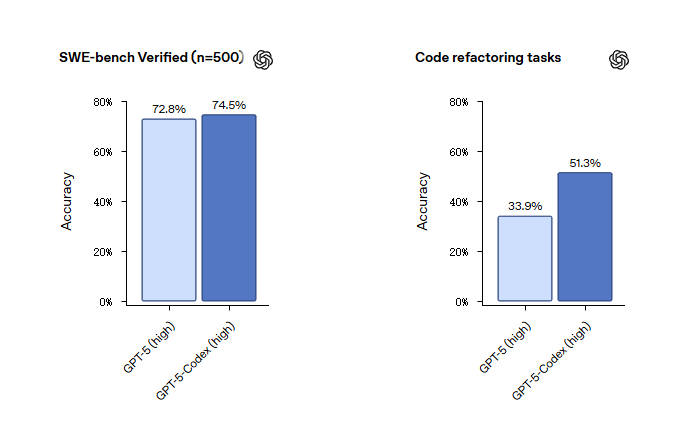
The model will reflect on the dynamics of the task, with a combination of two core competencies: working with developers in interactive sessions, and carrying out long-term tasks with lasting independence. This means that Codex is agile in dealing with clearly defined small tasks or chats, and sustainable work of more than seven hours in the face of complex tasks, such as large-scale re-engineering, with the ultimate delivery of a successful programme through iterative realization and repair of test failures.
In his briefing, Alexander Embiricos, the head of the OpenAI code product, stated that performance enhancement was largely the result of dynamic “thinking ability”. Unlike GPT-5 by route, GPT-5-Codex can adjust the duration of the mission in real time without a bottom route, and can even decide to extend the task by one hour after five minutes of processing – Embiricos’ access to some tasks of the model took more than seven hours.
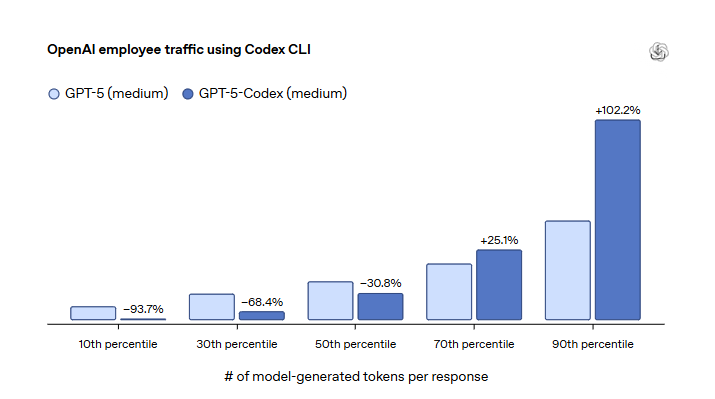
OpenAI internal tests show that in the lowest 10 per cent of the user command token, GPS-5-Codex saved 93.7 per cent of token consumption compared to GPT-5; in the top 10 per cent, the model devotes double time to reasoning, code editing testing and iterative.
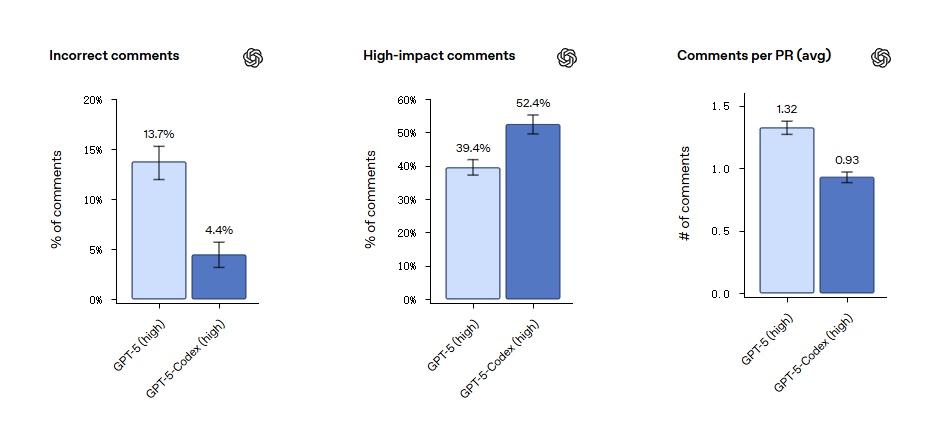
GPT-5-Codex specializes in code review and key deficiencies. The review enabled the navigation code library, reasoning dependence, running codes and testing to verify accuracy. Assessments based on recent submissions from the Hot Open Source Warehouse show that experienced software engineers believe that their review comments contain fewer errors or irrelevant elements that allow users to focus on key issues.
The model is reliable in front-end missions: in addition to the creation of a beautiful desktop application, it has been significantly enhanced in the humanization assessment of mobile website construction. The cloud works by deciphering the images or screenshots provided by the user, visualizing progress and providing feedback on the job screenshot.
GPT-5-Codex supports multi-tool calls for Codex CLI, Ide Extension, Cloud Environment and GitHub. Unlike the generic model GPT-5, OpenAI suggests that it be used only for intelligent body programming missions in Codex or similar environments.
Developers can access Codex through command lines, VS Code and other IDE extensions and cloud environments. CLI supports the design options of additional screenshots or diagrams, which allow the system to generate to-do lists and connect external tools such as web search or MCP servers.

GPT-5 Codex has been incorporated into the ChatGPT fee packages, which support multi-project operations on a weekly basis and allow the purchase of excess amounts by enterprise users. API integration is still being planned. The GPT-5-Codex code review errors were assessed by experienced engineers to be even smaller and to provide more “high-impact recommendations”.